

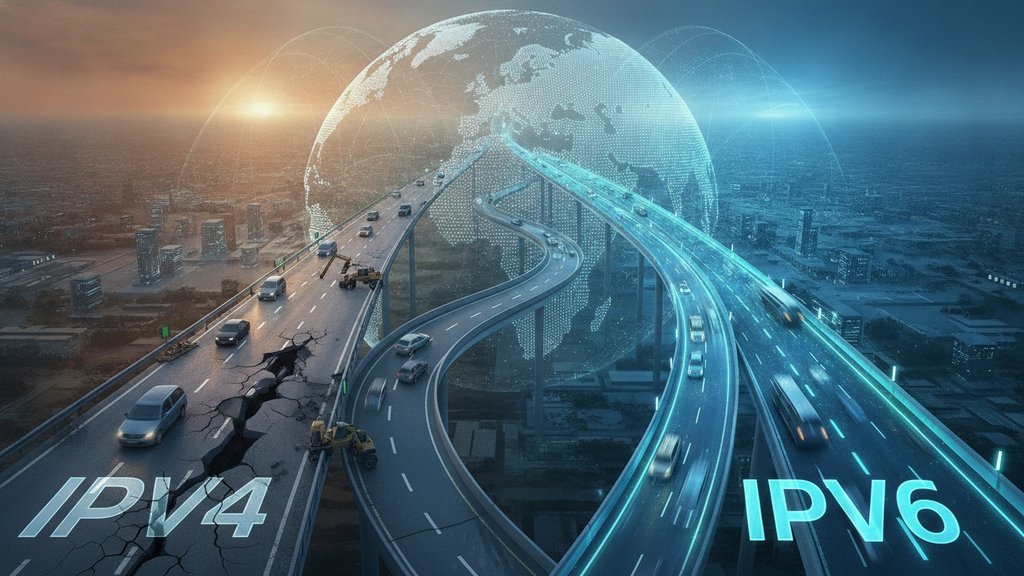
IPv6 adoption sits at roughly 40% to 45% of Google's users worldwide in 2026, meaning most of the internet still runs on IPv4 even though we officially ran out of fresh IPv4 addresses years ago. The transition is slow because IPv4 still works "well enough" thanks to workarounds like NAT and carrier-grade address sharing, and swapping the entire internet's plumbing costs money and effort that many networks keep postponing.
The short version: nobody is forced to move, dual-stack setups let providers delay a full switch indefinitely, and the pain of staying on IPv4 is spread thin enough that it rarely triggers urgent action. Below, we break down exactly where adoption stands, why it stalls, and when (if ever) IPv6 will truly replace IPv4.
Content Table
Where IPv6 adoption stands
Adoption is real but uneven. Google's IPv6 statistics page, which tracks the share of users reaching Google over IPv6, has hovered in the low-to-mid 40% range going into 2026. That number climbs a little every year, but the curve has flattened compared to the steep growth of the mid-2010s.
The bigger story is how much it varies by country and network type:
| Region / Segment | IPv6 adoption pattern |
|---|---|
| India, France, Germany | High (often 60%+), pushed hard by large mobile carriers |
| United States | Strong on mobile and major ISPs, roughly 50% |
| Mobile networks | Leaders, since many launched IPv6-only cores |
| Enterprise / corporate LANs | Laggards, many still fully IPv4 internally |
| Much of Africa and parts of Asia | Low single digits in several countries |
So the internet is not evenly split. A smartphone on a modern mobile network is very likely on IPv6 right now, while the office desktop next to you may never have sent an IPv6 packet.
IPv4 vs IPv6 explained simply
The whole transition exists because of one thing: address space. IPv4 uses 32-bit addresses, which caps the total at about 4.3 billion. That sounded huge in 1981 and looks tiny now with phones, laptops, smart TVs, cameras, and IoT sensors all needing connectivity.
IPv6 uses 128-bit addresses, defined in RFC 8200. That gives roughly 340 undecillion addresses, an amount so large it is effectively unlimited for any realistic purpose.
| Feature | IPv4 | IPv6 |
|---|---|---|
| Address length | 32-bit | 128-bit |
| Total addresses | ~4.3 billion | ~340 undecillion |
| Example | 192.0.2.1 | 2001:db8::1 |
| NAT needed? | Usually yes | No, every device can have a public address |
| Configuration | Manual or DHCP | Autoconfiguration (SLAAC) or DHCPv6 |
One key detail: IPv4 and IPv6 are not directly compatible. An IPv6-only device cannot talk to an IPv4-only server without a translation layer in between. That incompatibility is a big part of why nobody can just flip a switch overnight.
Why the transition is still slow
If the address shortage is so severe, why hasn't everyone moved? Because the pressure gets absorbed instead of forcing action. Here are the main IPv6 migration challenges keeping things stuck:
- NAT hides the shortage. Network Address Translation lets hundreds of devices share one public IPv4 address. Carrier-grade NAT (CGNAT) extends this to whole ISP customer bases, so users rarely feel the pain directly.
- IPv4 still works fine for the user. Websites load, streaming plays, games connect. There is no obvious "your internet is broken" moment pushing consumers to demand IPv6.
- Cost and risk of migration. Upgrading routers, firewalls, monitoring tools, and internal apps takes budget and staff. Every device and script that assumes an IPv4 format is a potential break point.
- Legacy hardware and software. Old load balancers, embedded systems, and internal tools may not support IPv6 at all, and replacing them is expensive.
- Skills gap. Many network teams are deeply comfortable with IPv4 troubleshooting and less practiced with IPv6 addressing, which slows confident rollouts.
- An IPv4 resale market. Unused IPv4 blocks now sell for real money, so organizations sitting on address space have a financial reason to keep using and trading it rather than abandon it.
Dual stack networking and why it delays the switch
Most networks that "support IPv6" actually run dual stack: they speak both IPv4 and IPv6 at the same time. A device gets both an IPv4 and an IPv6 address, and it uses whichever the destination supports (preferring IPv6 when both are available).
Dual stack is the safe, sensible migration path because nothing breaks. But it is also the reason the transition drags on:
- Since IPv4 keeps working alongside IPv6, there is never a hard deadline to shut IPv4 off.
- Running both protocols means maintaining two sets of firewall rules, routing, and monitoring, which is more work, not less.
- As long as any major service stays IPv4-only, everyone else must keep their IPv4 stack alive to reach it.
The endgame most experts point to is IPv6-only networks with a translation mechanism (like NAT64/DNS64) for the shrinking pool of IPv4-only destinations. Some large mobile carriers already run this way internally. If you manage services and want to understand how connections reach devices behind shared addresses, our guide on how port forwarding works explains the plumbing that IPv6 largely eliminates by giving every device a routable address.
When will IPv6 replace IPv4
Honestly, "replace" may be the wrong word for a long time. The realistic outlook:
- Near term (next few years): IPv6 adoption keeps climbing slowly, mostly driven by mobile and large consumer ISPs. IPv4 stays universal as a fallback.
- Medium term: More networks go IPv6-first internally and treat IPv4 as a legacy compatibility layer accessed through translation, not a primary protocol.
- Long term: IPv4 fades to a small, translated corner of the internet rather than vanishing on a specific date. There is no planned "IPv4 shutdown day."
The future internet is clearly IPv6, but it arrives through gradual displacement, not a dramatic cutover. The trigger that would speed things up is IPv4 addresses becoming genuinely expensive or scarce enough that CGNAT can no longer paper over the gap.
How to check your own IPv6 readiness
Whether you are a curious user or run a website, it helps to know if IPv6 is actually working on your end. A few practical checks:
- Test a website's IPv6 support to see if a domain answers over IPv6 at all, which tells you whether the operator has done any IPv6 implementation.
- Look up DNS records for a domain: an AAAA record means IPv6 is configured, while only an A record means IPv4-only. You can run this with a DNS lookup.
- Convert and inspect addresses when you are working across formats using an IP address converter to move between representations.
For consumers, the quickest signal is simple: if a modern site loads and your connection info shows an address starting with something like
2001:
or
2600:
, you are already on IPv6 without doing anything.

See if a site is ready for the IPv6 transition
Curious where a domain stands on IPv6 adoption? Our free IPv6 website test checks whether a site actually answers over IPv6 or is still IPv4-only, so you can spot who has done the migration and who hasn't.
Test a website for IPv6 →
Frequently asked questions
Measured by Google's user statistics, IPv6 adoption sits around 40% to 45% globally in 2026. It varies widely by country, with places like India, France, and Germany above 60%, while some regions and most corporate internal networks remain in the low single digits.
Because IPv4 and IPv6 are not directly compatible. A huge amount of the internet still runs IPv4-only, so devices must keep an IPv4 stack (or use translation) to reach those services. Until IPv4-only destinations become rare, dropping IPv4 entirely would break connectivity.
No. Dual stack means a network runs IPv4 and IPv6 side by side, so IPv4 still carries traffic. True migration ends with IPv6-only networks that use translation only for legacy IPv4 destinations. Dual stack is a transition stage, not the finish line.
There is no planned shutdown date. IPv4 is expected to shrink into a small, translated legacy layer over many years rather than disappear on a specific day. It fades through gradual displacement as more networks go IPv6-first and fewer services stay IPv4-only.
Check whether your device has a public address starting with a hexadecimal block like 2001: or 2600:, or run an IPv6 website test. You can also do a DNS lookup on a domain: an AAAA record means IPv6 is configured, while only an A record means IPv4-only.